Illustration by Maliha Ali
Instructor Alexa Tang works at the intersection of AI product design and AI adoption.
At Thomson Reuters, she helped design experiences that enable legal professionals to review, validate, and refine AI-generated content. She is currently a Lead UX Designer at Caseware International, where she focuses on AI-assisted audit workflows and client collaboration experiences. She also leads internal AI enablement initiatives, helping teams develop the workflows, knowledge systems, and practices needed to work effectively with AI.
The UX Design for AI: Human-AI Collaboration course is built from the same challenges, experiments, and lessons she encounters in her work every day—helping designers learn how to work with AI, design for AI, and navigate AI transformation responsibly.
What sets this course apart and why is it relevant?
Most AI courses teach either how to use AI tools or how to think about AI responsibly – rarely both, and rarely in sequence. This course is deliberately structured, so the first four weeks build judgment for designing AI systems – decision architecture, trust, and human-in-the-loop patterns – before students turn AI tools on their own practice from week five (Claude, v0, Cursor). That order matters: “designing AI” and “using AI to design” are related, but they are different skills.
Trust and transparency are not isolated in a single ethics module; they are treated as design constraints throughout the course. The experience is also live and cohort-based rather than self-paced: students learn through real-time case discussion, peer critique, and applied work. It is grounded in enterprise product practice, not just tool demonstrations or theory.
Why is AI literacy critical, and its ethical and responsible use vital?
When AI starts making or shaping decisions inside workflows, the question is not simply whether a human is “in the loop” – it is whether that checkpoint is load-bearing or theater. Designers need enough AI literacy to recognize automation bias, mismatches between system behavior and a user’s mental model, and situations where uncertainty or potential impact should trigger human judgment.
Without that literacy, teams can automate the wrong thing, add superficial review steps that do not change outcomes, or create systems users cannot meaningfully understand or challenge. Ethical and responsible AI design is therefore a core design skill, not a compliance add-on. Students learn to design human oversight that is purposeful, legible, and accountable.
Who is this course for?
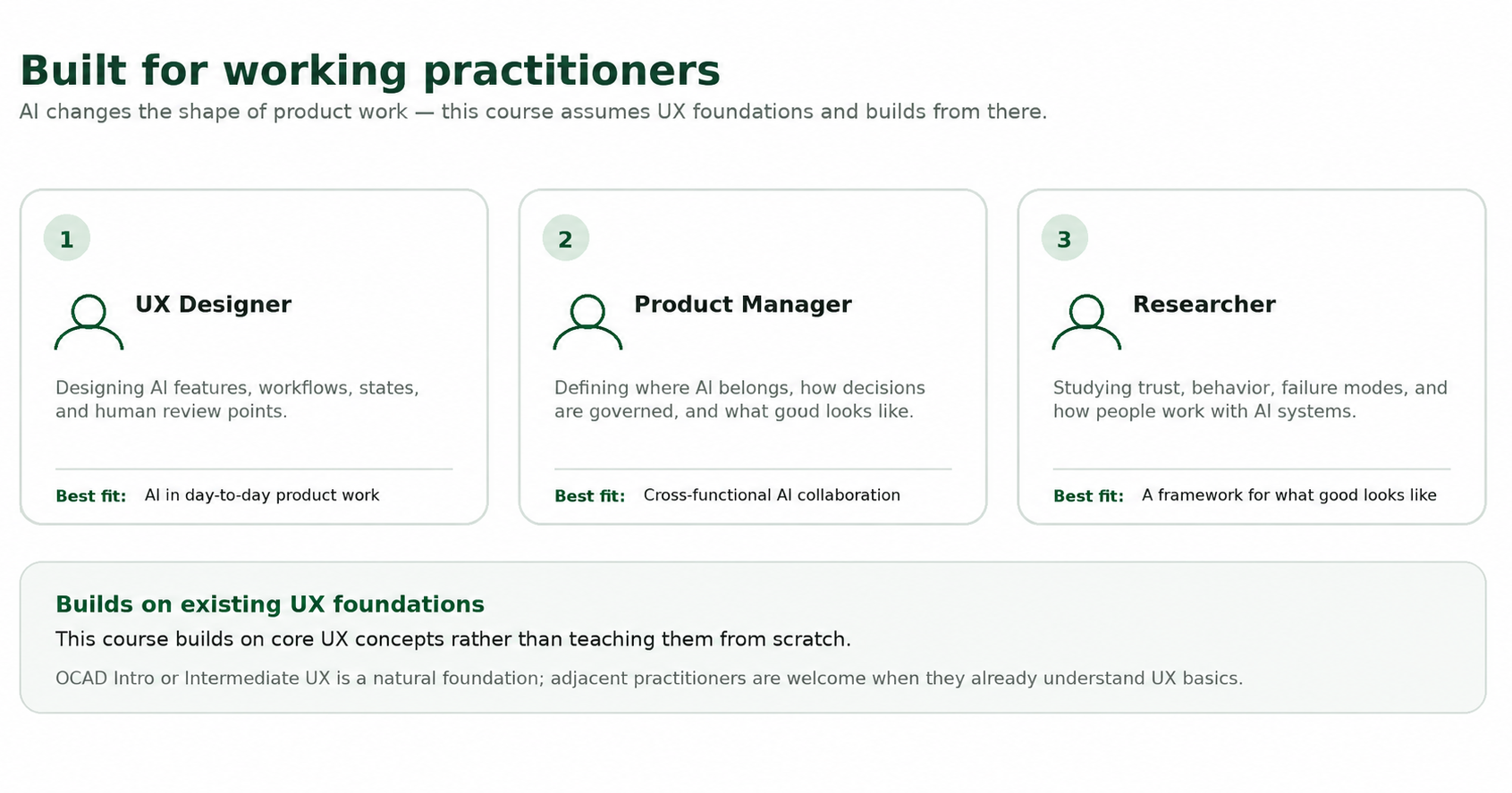
This course is built for mid-to-senior working practitioners - UX designers, product managers, and researchers - who are encountering AI in real product work. It assumes you already have UX foundations; it builds on them rather than teaching UX from scratch. OCAD U's Introduction or Intermediate UX courses are a natural foundation.
The strongest fit is someone designing features with AI components, collaborating with AI-augmented teams, or being asked to "use AI more" without a framework for what good looks like. It can also suit adjacent practitioners moving into more AI-intensive product work, provided they already understand core UX concepts. The course is positioned as a natural next step after existing UX offerings at the School of Continuing Studies.
What can students expect?
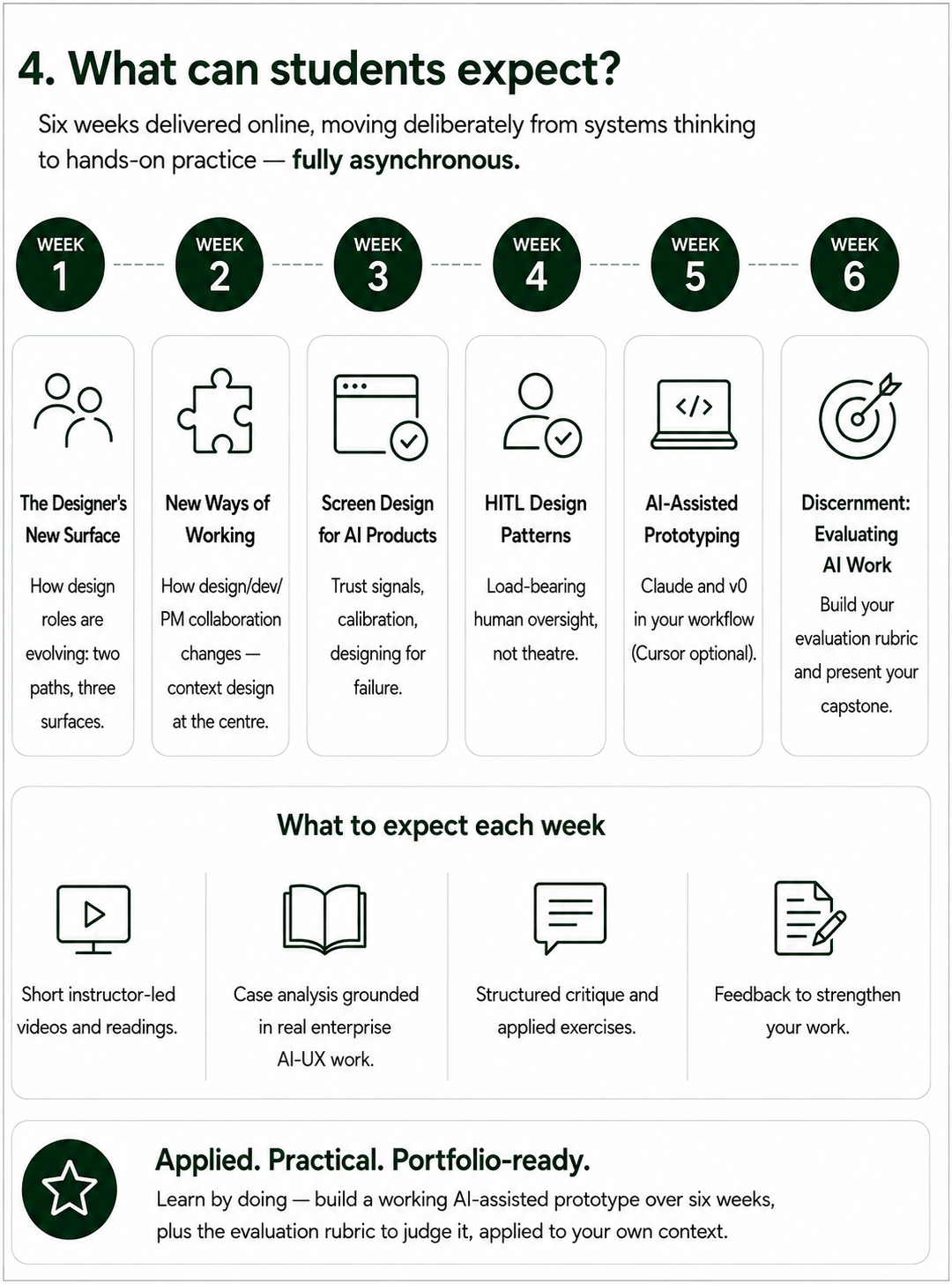
Six weeks, delivered online, asynchronously. The course moves deliberately from systems thinking to hands-on practice: The Shift (how design roles are evolving), New Ways of Working (design/dev/PM collaboration on AI products), Decision Architecture, HITL Design Patterns, AI-Assisted Prototyping (Claude, v0, Cursor), and Measuring Success, ending in a capstone presentation.
Each weekly module combines short instructor-led framing with case discussion grounded in real enterprise AI-UX work, structured peer critique, and in-class application—this is not a lecture-and-quiz format. Students bring their own context (a live project, a hypothetical, or a case from work) and build toward a capstone they present in week six. Evaluation is applied rather than exam-based: weekly application exercises, a capstone deliverable, and dedicated instructor feedback throughout.
What will students gain from this course?
Students leave having built a working AI-assisted prototype—not just a static mock-up—and with a decision framework for where AI belongs in a workflow, where human judgment must remain, and how to evaluate whether the experience is actually working. The course deliberately puts judgment before tool fluency, so students learn to use Claude, v0, and Cursor inside a design process rather than treat them as prompt-to-picture tools.
Students also leave with a capstone project suitable for a portfolio, experience critiquing and iterating on AI-generated work against intent and design standards, dedicated instructor feedback, and a cohort of peers facing the same shift in their own organizations. The goal is to return to their teams able to make a credible case for how AI should—and should not—show up, and to turn that judgment into something testable.
Register today!